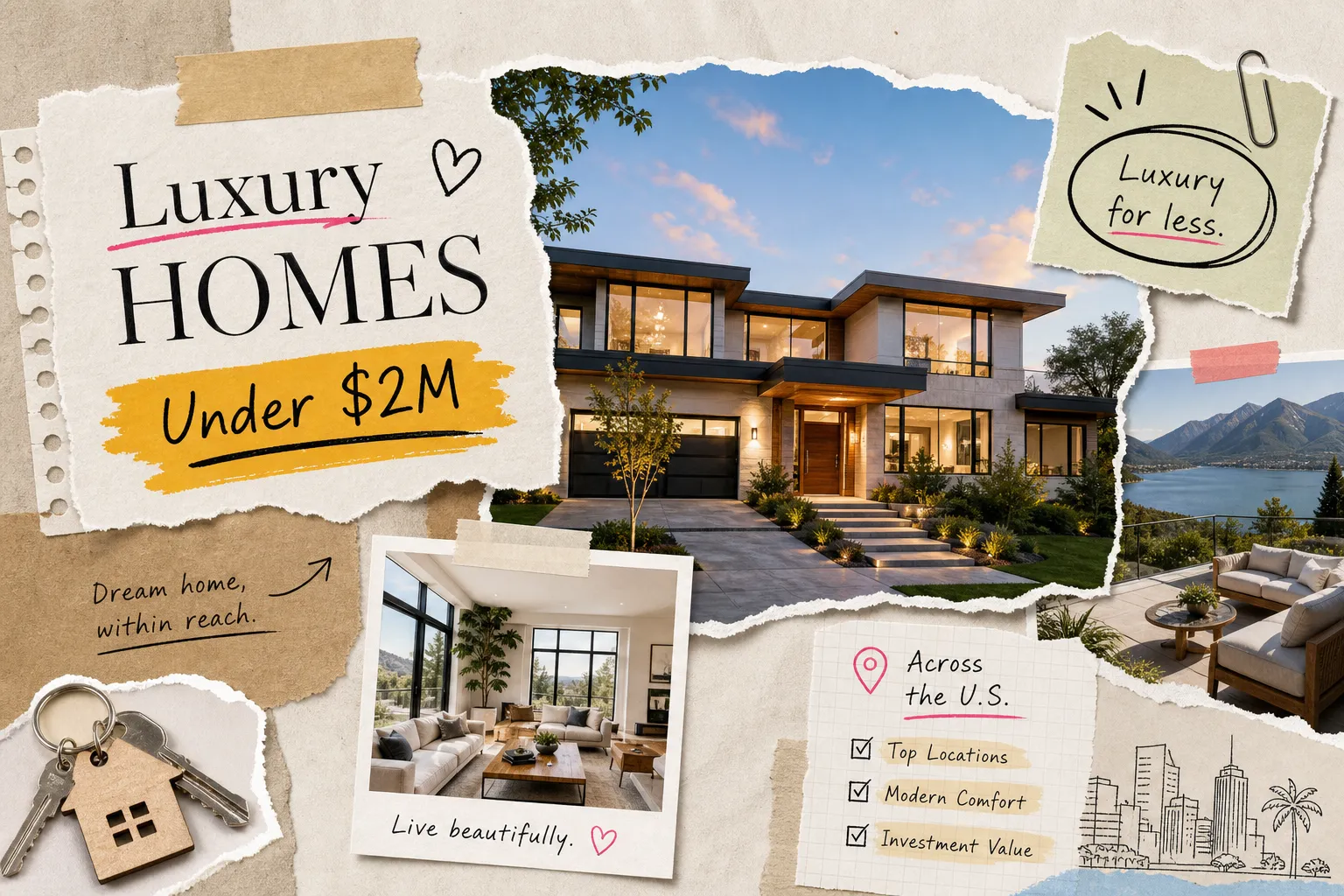
What are the best luxury homes for sale under $2 million in the US right now? The answer depends heavily on which market you're shopping, and two million dollars still carries remarkable power across most of the country. In dozens of metros, that budget buys an estate with five bedrooms, a resort style pool, a chef's kitchen and finishes that would look at home in an architectural magazine. In others, it lands a penthouse on a high floor with skyline views and full service building amenities. The challenge is knowing which market delivers which promise, and knowing how to move the moment you find the right property.
This guide maps the U.S. luxury landscape for buyers working under a $2 million budget. It covers where the best value plays are concentrated right now, what you'll realistically get in each type of market, how the financing works, and how to position yourself to actually win one of these homes. The research draws on 2026 national listing data and insights from top producing agents across the country, including my colleagues at Compass, the largest residential brokerage in the U.S., who track market shifts in real time.
What luxury actually means when your budget is $2 million
The real estate industry doesn't define luxury by a single price tag. It's a combination of finish quality, location exclusivity, lot and square footage, and the features that separate a home from a standard premium listing. That definition shifts dramatically depending on the market. In coastal cities like Los Angeles or New York, $2 million often sits right at the entry point for luxury. In the Midwest or South, the same budget places you firmly in the top one to two percent of all active listings in the metro.
When you're evaluating whether a specific listing is truly luxury or simply high priced, look for the tangible markers: a resort style pool with an outdoor kitchen, a chef's kitchen with Sub-Zero and Wolf appliances, a primary suite with a spa grade bathroom, a smart home system that unifies lighting, climate and security, and a private lot with mature landscaping or real acreage.
Neighborhood positioning matters just as much as the home itself. A beautifully finished house on the wrong street is not a luxury asset. A slightly older home in a premier enclave often is.
The U.S. metros where $2 million buys the most right now
Redfin's 2026 luxury market data identifies Detroit, Cleveland, Pittsburgh, Cincinnati and San Antonio as the most affordable major metros for luxury home buyers. In Detroit, the median luxury sale price runs around $719,000. Cleveland sits near $833,000, and Pittsburgh close to $904,000. For a buyer with $2 million to spend in any of these markets, the budget isn't just competitive, it's dominant. You're looking at the top tier of what these cities offer, with room to be selective about features and lot size.
Realtor.com research supports this from another angle. San Antonio's luxury entry threshold is $750,510, meaning the top ten percent of listings in that market start below $800,000. Houston's entry point is $794,000, and Charlotte's is close to $899,000. A $2 million budget in any of these cities places a buyer well above the luxury baseline, typically into estate scale properties with larger lots, pools and higher finish levels than anything else in the market can offer.
Middle tier markets with strong features and growing prestige include Atlanta, Nashville, Chicago's western suburbs and the DFW area. In Atlanta's Sandy Springs and Brookhaven neighborhoods, $2 million commonly delivers four to five bedrooms, a chef's kitchen with a scullery, a finished basement, a three car garage, and as much as one to 1.5 acres in the estate focused areas north of the city. Nashville's Green Hills and West Meade corridors offer large lots, privacy and high end finishes at a price point that feels like real value next to coastal alternatives. In DFW, Preston Hollow and Westlake are the addresses where this budget lands resort style pools and premium construction. Chicago's Hinsdale and Western Springs deliver the same level of finishes and outdoor space in suburbs with strong school access and easy city proximity.
What $2 million looks like on the coasts and in the Sun Belt
In New York, $2 million is real money, but it's a different kind of real estate. The luxury entry threshold in that metro sits near the top of this budget range, so buyers generally find condos on high floors in neighborhoods like Williamsburg or Long Island City, with views, rooftop pools and full service building amenities rather than private estates. That's a legitimate luxury product. Just go in with calibrated expectations about what the format will be. The tradeoff is square footage for location and services.
Los Angeles at this price point typically delivers a well finished home in a desirable suburb with strong school access and solid neighborhood cachet. Miami stands out for sheer inventory depth, with over 10,000 active million dollar listings heading into 2026. The key in that market is knowing which neighborhoods represent real value versus which ones are priced primarily for the brand name of the zip code. Coconut Grove, Palmetto Bay and parts of Pinecrest tend to offer more square footage and lot size than the same budget would get on the barrier islands.
Austin's luxury segment shows clear buyer opportunity right now. The median sold price in the segment above $1 million runs around $1.33 million to $1.40 million in 2026, and months of supply across the $1 million to $4 million band range from 2.9 to 5.8 depending on price tier. Buyers working between $1.5 million and $2 million have more negotiating room than they did two years ago, particularly in acreage communities and estate lot neighborhoods on the edges of the metro. That window may not last as population growth continues to push demand upward.
Why Kansas City is one of the smartest luxury plays under $2 million
Kansas City doesn't always come up in national luxury conversations, but it should. Mission Hills, Leawood and Hallbrook are the metro's premier luxury addresses, and a $2 million budget in any of these neighborhoods doesn't just get you in the door, it puts you at the very top of the market. Mission Hills median sale prices are running between $1.45 million and $1.69 million in 2026 data, meaning a serious buyer in this range has meaningful selection across the neighborhood's best inventory. Leawood and Hallbrook deliver comparable architectural quality, strong school access, and the kind of private lot and finish level that define true luxury at this price point.
My buyers also get something most Kansas City searches can't access: early visibility into homes that haven't hit the public market yet. Compass Private Exclusives and Coming Soon listings let serious buyers see properties before they appear on Zillow or Realtor.com. In a market where the best addresses move quickly, that's not a minor convenience, it's a structural advantage. Buyers who see a home first, and arrive prepared, are the ones who win it.
The Compass platform adds an intelligence layer that changes how a search actually works. AI powered market tools surface opportunities and signals in real time that a standard portal search simply won't catch. I use that infrastructure to keep clients ahead of market movement rather than reacting to it, surfacing active listings, upcoming inventory and neighborhood data that shapes a smarter offer strategy from day one.
Financing a luxury home under $2 million in 2026
Jumbo 30 year fixed rates are running roughly 6.6 to 6.8 percent as of 2026, with 15 year options closer to 5.9 to 6.1 percent. At a standard 20 percent down payment on a $2 million purchase, that's $400,000 down and a $1.6 million loan. At 6.7 percent, the monthly principal and interest payment lands around $10,340. A scenario with ten percent down produces a $1.8 million loan and monthly principal and interest around $11,630. These numbers are real and manageable for buyers earning roughly $300,000 or more annually, the income profile that typically qualifies at this price point. Keep in mind that total monthly costs, including property taxes, insurance and any HOA dues, will run meaningfully higher than the loan payment alone.
Jumbo lenders have specific requirements that buyers need organized before they start making offers. Expect to document two years of income, show six to twelve months of mortgage payment reserves in liquid assets, maintain a credit score of 720 or above, and demonstrate a debt to income ratio that meets the lender's guidelines. Buyers who arrive with financing fully approved in advance don't just look more credible to sellers, they can move faster, which in a competitive luxury segment is often the deciding factor between winning a home and losing it to someone equally qualified who got there first.
How to find, tour and make a winning offer
Setting up your search correctly matters more than most buyers realize. On the public portals, use price filters in the $1.5 million to $2 million range combined with filters for square footage, lot size and specific features like a pool or acreage. Set saved search alerts on Realtor.com and Zillow so new listings reach you the same day they enter the market.
That said, public portals often show listings hours or even days after they've entered the market, and they will never surface Compass Private Exclusives or Coming Soon inventory. For a full picture of what's available, working with an agent who has access to those channels isn't optional. It's the difference between seeing the whole board and playing with half the pieces.
During tours, focus on the systems and infrastructure that don't show up in listing photos. Ask about the age and service history of the HVAC, roof condition, what the smart home system actually covers, and HOA rules if they apply. These details affect both the ownership experience and the long term value of the asset. For offers, the competitive levers include a strong approval letter or proof of funds, escalation clauses where you expect multiple offers, and limiting contingencies where your risk is manageable. In some markets that favor sellers, a thoughtful personal letter still carries weight. In all markets, speed and preparation separate buyers who win from those who keep watching properties sell to someone else.
The bottom line on luxury under $2 million
The best luxury homes available under $2 million right now are spread across a wider range of markets than most buyers expect. Value luxury metros like Detroit, Cleveland and San Antonio let this budget dominate the top of the market with estate scale features and healthy inventory. Middle tier cities like Nashville and Atlanta deliver strong finishes, acreage and lifestyle in neighborhoods with real prestige. Coastal markets require sharper neighborhood knowledge and realistic expectations about the product. And Kansas City stands out as a market where $2 million places a buyer at the very pinnacle of available inventory, especially with early access to homes that never reach the public portals.
Whether you're relocating, investing or upgrading from your current home, the window on luxury under $2 million is real. Markets that favor buyers don't stay that way forever, and the best properties rarely wait for buyers who aren't ready to move. If Kansas City is anywhere on your list, I'd love to put that early access to work for you. Reach out anytime.